
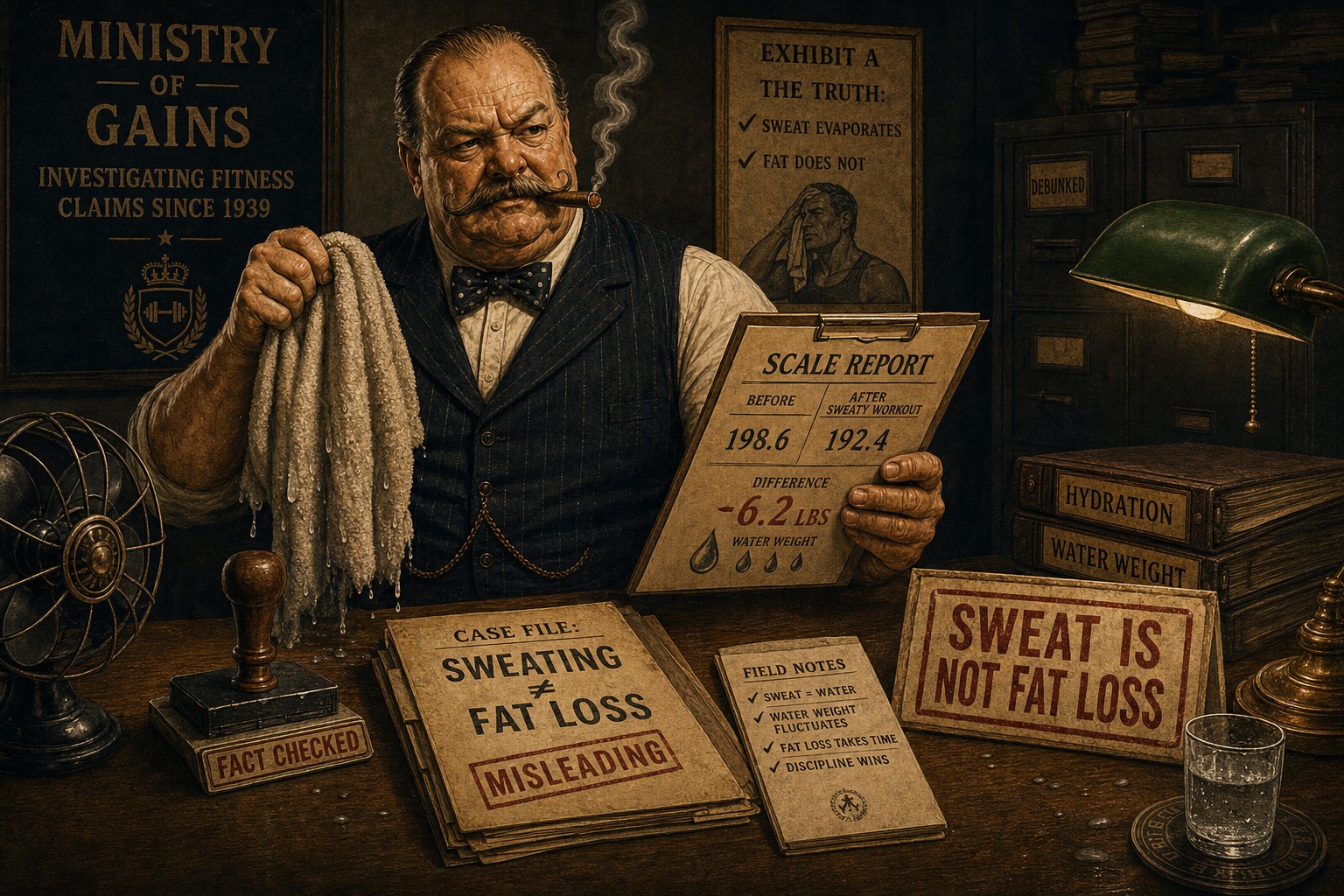
There persists, within the fitness industry, a curious belief that refuses to perish despite repeated encounters with basic human physiology. It survives every generation. It migrates from gym to gym. It reappears in magazine advertisements, social media videos, and conversations between well-meaning individuals wrapped in enough neoprene to survive a deep-sea expedition.
The belief is simple: the more one sweats, the more fat one burns.
The logic appears sound at first glance. A man exits a workout looking as though he has just completed a rescue mission during a tropical hurricane. His shirt weighs approximately six pounds more than when he arrived. The floor beneath him resembles a recently mopped kitchen. Nearby observers nod approvingly. Surely, they reason, such suffering must be accomplishing something extraordinary.
And indeed it is.
Unfortunately, that something is not fat loss.
Many years ago, I too subscribed to this doctrine. I regarded sweat as evidence of progress. If a workout left me drenched, I considered it successful. If I remained relatively dry, I suspected laziness. During summer workouts I interpreted discomfort as achievement. During winter workouts I viewed comfort with deep suspicion.
Had someone informed me that fat loss could be accelerated by exercising inside a parked automobile in August, I might have considered the proposal.
The misunderstanding arises because sweat is visible. Human beings adore visible evidence. We enjoy indicators that can be observed immediately. A swollen bicep after a workout feels productive. A sore muscle feels productive. A puddle of sweat feels productive. These things provide instant feedback.
Actual fat loss, by comparison, behaves like government paperwork.
It proceeds quietly.
It takes longer than anyone would prefer.
And it rarely announces itself.
The unfortunate reality is that sweat is not body fat leaving the body. Sweat is primarily water and electrolytes. Its purpose is not to make you leaner. Its purpose is to prevent your organs from becoming an unpleasant internal casserole.
That is the entire mission.
The body becomes warm. The cooling system activates. Sweat appears. The moisture evaporates. Heat escapes.
Case closed.
If perspiration truly measured fat loss, the most effective fitness facilities in existence would be saunas. Citizens would simply sit motionless in heated rooms until achieving their desired body composition. The Ministry has reviewed this possibility extensively and regrets to report that reality remains uncooperative.
Consider the wrestler attempting to make weight before competition. Through dehydration, sweat suits, and various unpleasant rituals, he may lose several pounds within a single day. The scale confirms the reduction. The weight has undeniably disappeared.
Then comes the remarkable twist.
The wrestler drinks water.
The weight returns.
This is because the lost weight was not fat. It was merely water temporarily persuaded to leave the premises.
Fat behaves differently. Fat loss occurs when the body consistently requires more energy than it receives. Over time, stored energy reserves are utilized to close the gap. The process is slow, stubborn, and entirely indifferent to how dramatic your workout appears from across the room.
One person may lose substantial body fat while walking outdoors during pleasant weather, barely sweating at all. Another may spend an hour inside a room heated to the approximate temperature of a pizza oven, soaking through three shirts while making absolutely no progress toward their goals.
The body, as always, remains committed to facts rather than appearances.
This reality disappoints many people because sweat feels heroic. There is something emotionally satisfying about visible struggle. We enjoy the notion that greater discomfort must automatically produce greater results. It appeals to our sense of fairness. If we suffer enough, surely the universe owes us a reward.
Yet biology continues its long tradition of ignoring our preferences.
The effectiveness of a training program is not measured by how much moisture accumulates in your socks. It is measured by whether the program can be repeated consistently, whether strength improves, whether health improves, and whether sensible nutrition accompanies the effort.
In short, the objective is not to become a human sprinkler system.
The objective is to become stronger, healthier, and more capable than you were yesterday.
Perspiration may attend the meeting.
It is not running the department.