
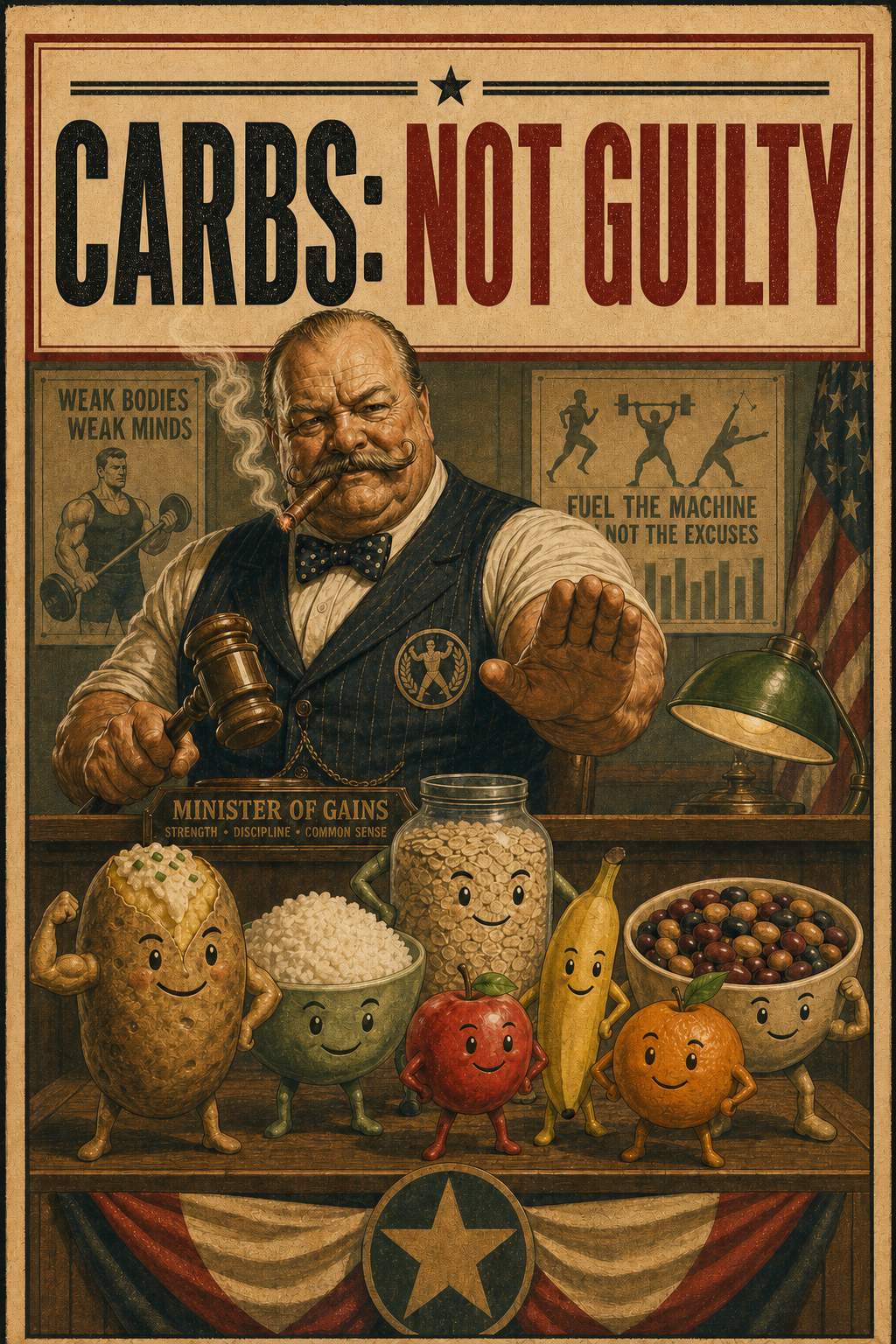
Carbs have been found supplying training fuel while influencers accused them of treason. Charges dismissed.
For the better part of two decades, carbohydrates have been treated like the sketchy cousin who shows up at Thanksgiving and immediately gets blamed for everything.
Can't lose weight? Carbs.
Feeling bloated? Carbs.
Forgot your anniversary? Somehow... probably carbs.
Meanwhile, carbohydrates have quietly continued doing what they've always done: providing energy to human beings.
This week, after a lengthy review of the evidence, the Court of Common Sense has officially dismissed all charges.
The defendant is free to return to normal life.
Exhibit A: Humans Have Been Eating Carbs Forever
It's easy to forget that carbohydrates weren't invented by a cereal company in 1987.
Rice. Potatoes. Fruit. Oats. Corn. Beans.
People have been eating carbohydrate-rich foods for thousands of years. Entire civilizations were built on them. In fact, most of the strongest, hardest-working populations in history got a significant portion of their calories from carbohydrates.
The ancient Romans didn't build roads across Europe fueled by cauliflower crust pizza.
They ate grain.
A lot of grain.
Exhibit B: Your Muscles Love Carbs
When you lift weights, sprint, play sports, or perform any activity that requires effort beyond leisurely scrolling social media, your body relies heavily on glycogen.
Glycogen is simply stored carbohydrate.
It's the premium fuel source for high-intensity work.
This isn't controversial. It's not a theory. It's basic exercise physiology.
If you've ever experienced one of those workouts where everything feels strong, explosive, and easy, there's a good chance your glycogen stores were full.
If you've ever tried a workout after three days of surviving on black coffee, bacon, and motivational quotes, you may have noticed a different result.
Science refers to this condition as "feeling like garbage."
Exhibit C: Weight Gain Is Not a Carbohydrate Conspiracy
One of the biggest misunderstandings in fitness is the belief that carbohydrates somehow bypass the laws of physics.
They do not.
Eating more calories than you burn causes weight gain.
Eating fewer calories than you burn causes weight loss.
Carbohydrates are subject to the exact same rules as fats and proteins.
Yes, it's possible to overeat carbs.
It's also possible to overeat peanut butter, olive oil, trail mix, almonds, and every other food that health influencers conveniently forget contains calories.
The issue is usually not that someone ate a baked potato.
The issue is that they ate a baked potato, half a pizza, four beers, and then finished the night investigating the ice cream section like a detective working a cold case.
Exhibit D: The Influencer Economy Needs Villains
Fitness trends thrive on simple stories.
Complex truths don't sell very well.
"Eat a balanced diet and manage your calorie intake" doesn't generate many clicks.
"THIS ONE FOOD IS DESTROYING YOUR METABOLISM" does.
Every few years a new dietary villain emerges. Fat was the enemy. Then sugar. Then carbs. Then gluten. Then seed oils. Then something else.
The details change.
The outrage remains remarkably consistent.
Final Verdict
Are carbohydrates magical?
No.
Are they required for survival?
Also no.
But for active people who enjoy training, recovering, performing, and generally having enough energy to function without staring blankly at walls, carbohydrates can be extremely useful.
The evidence is overwhelming.
The jury deliberated for approximately six seconds.
Carbohydrates are hereby found not guilty of ruining civilization.
Court is adjourned.
You may now enjoy your potato.